
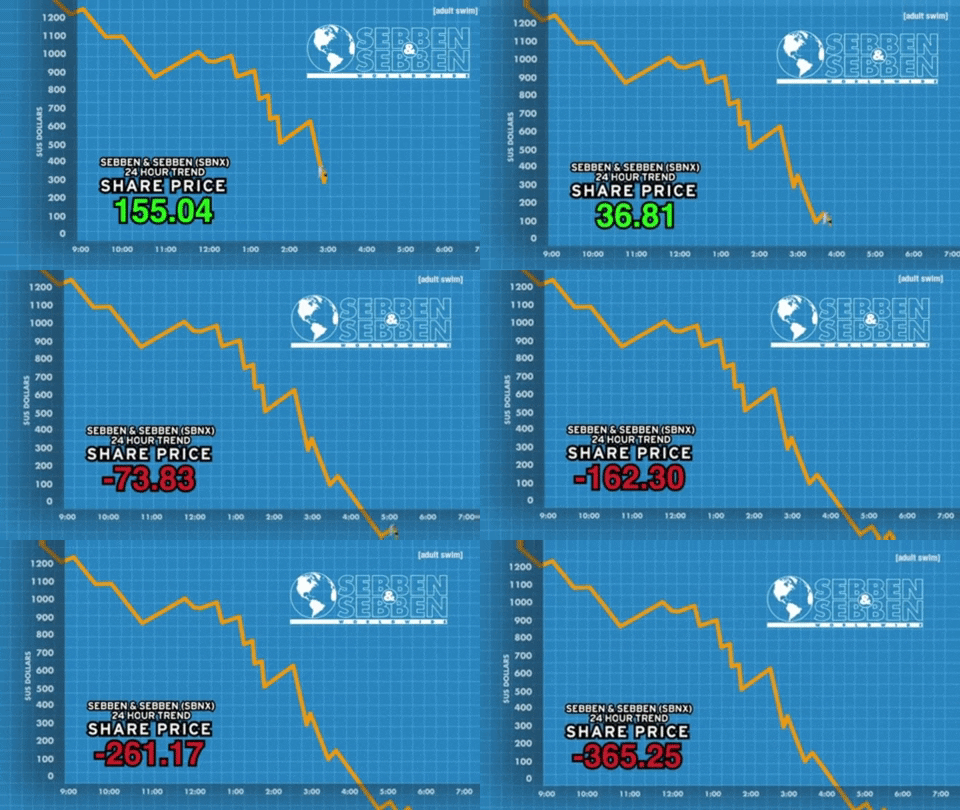
Why Debt Snaps and Equity Bends
The structural difference between fixed-income debt and equity resilience
Loan notes promise certainty.
Fixed return.
Fixed term.
Fixed redemption.
Lovely on a factsheet.
But certainty requires one thing:
Predictability.
And property development margins, refinancing cycles, planning timelines, buyer demand and legal processes are about as predictable as the British weather.
Sunny brochure.
Stormy balance sheet.
Here's the Structural Bit Most People Skip
Debt requires:
- Fixed interest payments
- Fixed redemption date
- Fixed timing assumptions
It does not care if build costs rise.
It does not care if exit values soften.
It does not care if refinancing windows shut for 18 months.
Debt demands.
If cash flow isn't there on schedule, the structure fractures.
When performance slows in debt:
It defaults.
And default isn't a vibe shift.
It's legal.
Administrators.
Standstill agreements.
Recovery negotiations.
That's the mechanical outcome.
Not drama. Mechanics.
Equity Plays a Different Game
Equity allows:
- Variable distributions
- Extended time horizons
- Asset ownership continuity
- Participation in upside
When performance slows in equity:
It adjusts.
Dividends reduce.
Hold periods extend.
Cash is conserved.
Assets remain.
There's no redemption clock ticking in the background like a bomb in a Netflix thriller.
That's not theory.
That's structural flexibility.
The Last Few Years Were a Stress Test
2020–2024 wasn't normal.
Rates moved aggressively.
Refinancing became selective.
Liquidity thinned.
Buyer appetite cooled.
And suddenly high-yield "fixed income" products weren't looking so fixed.
They worked beautifully in bull markets.
They suffocated when liquidity tightened.
Because they were built for momentum — not stress.
And stress eventually arrives.
Always.
The Illusion of Safety
Let's be blunt.
A 12% "fixed" coupon feels safer than 8% variable equity.
Psychologically.
But structure matters more than optics.
Debt amplifies pressure.
Equity absorbs it.
Debt compresses time.
Equity expands it.
Debt accelerates failure.
Equity slows it down.
If you're advising clients through cycles — not just quarters — this distinction is everything.
| Metric | Fixed-Income Debt | Equity Platform |
|---|---|---|
| Cash-flow timing | Rigid — fails on delay | Flexible — adjusts to conditions |
| Response to rate rises | Refinancing risk spikes | Asset values compress, income persists |
| Response to recession | Default / administration | Dividend reduction / hold extension |
| Recovery profile | Binary — par or impairment | Gradual — participates in recovery |
| Time horizon | Fixed (pressure builds) | Flexible (time heals) |
| Credit Segment | Market Size | 2024 Growth | Key Risk |
|---|---|---|---|
| Global public credit | $135T | +4.2% | Duration sensitivity |
| Direct lending (private) | $1.7T | +23% | Illiquidity premium compression |
| CLO market | $1.1T | +18% | Correlation in stress |
| Private credit (total) | $2.1T | +21% | Mark-to-model opacity |
The Adviser Divide
The advisers who survive multiple cycles aren't the ones who chase coupons.
They're the ones who interrogate structure.
They ask:
- Where does cash flow actually come from?
- What happens if refinancing disappears?
- Can this survive 24 months of stress?
- Who controls the assets in a downturn?
They don't sell yield.
They underwrite resilience.
Because yield without structure is just risk wearing makeup.
And makeup washes off when it rains.
Next, we explore what durable real estate equity structures actually look like — and why institutional capital prefers them over fixed-income retail debt.
If you're reviewing exposure and thinking,
"Right… we may need to recalibrate,"
We should speak.
Structural Insight. Direct to Your Inbox.
The intelligence your competitors haven't read yet.
Let's talk. Quietly. Properly. Professionally.