
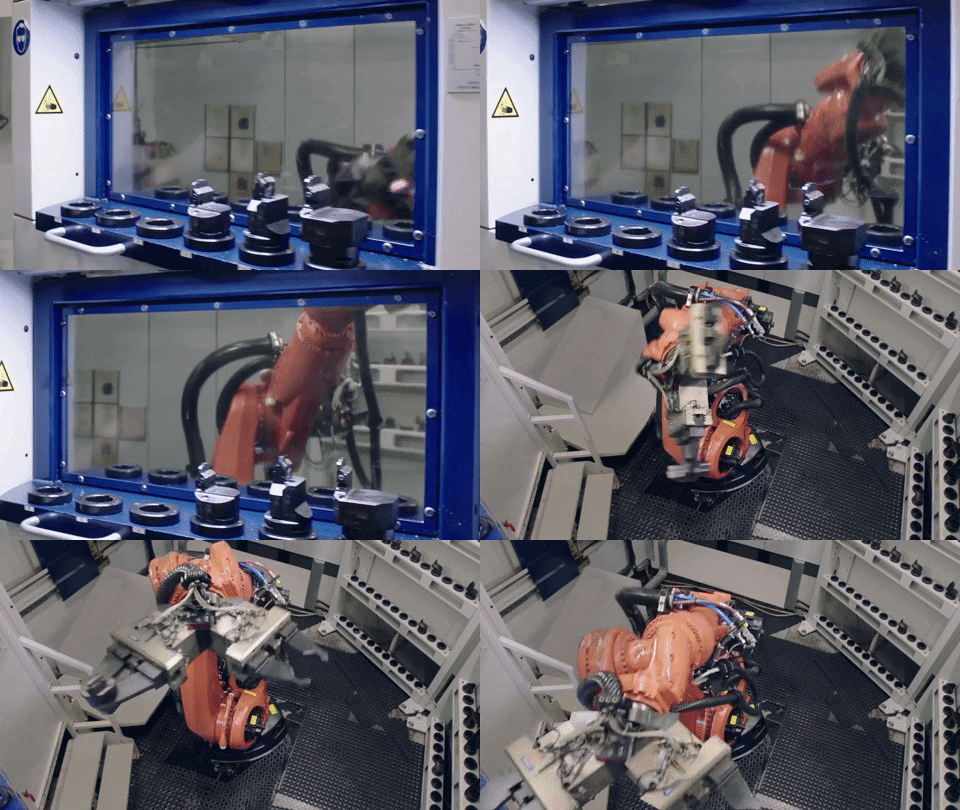
The Physical Weight of the Cloud
When $562 billion in AI CapEx collides with ageing power grids and factory floors
Everyone thinks AI lives in the cloud.
Weightless. Ethereal. Pure software.
Wrong.
AI lives in concrete, copper, and cooling towers. It drinks electricity like a steel mill. It demands land, water, planning permission, and physical infrastructure at a scale the market hasn't priced in.
The $562 billion annual CapEx wave isn't a software story.
It's a construction story.
The Numbers That Should Bother You
In 2024, the five largest hyperscalers — collectively — spent more on physical infrastructure than the GDP of Colombia.
That's not an analogy. That's arithmetic.
| Metric | Value | Source |
|---|---|---|
| Global AI-related CapEx (2024) | $562B | Goldman Sachs |
| US data centre power demand by 2027 | 4.1 GW (new capacity) | McKinsey Energy |
| Industrial robotics market (2025 est.) | $28B | IFR / Statista |
| Average data centre build cost | $7–12M per MW | JLL Data Centre Report |
| Water usage per 1MW data centre | ~26M litres/year | Uptime Institute |
When Microsoft tells you it's "investing in AI," what it actually means is: pouring concrete in Iowa, installing transformers in Virginia, and fighting local planning boards in rural Europe.
The software is interesting. The capex is investable.
The Grid Problem Nobody Wants to Talk About
Here's the quiet crisis.
US electricity demand was essentially flat for two decades. Utilities planned around that flatness. Grid capacity reflected it.
Now AI has arrived — and it needs power like a small country.
A single large language model training run can consume the same electricity as 1,000 US households use in a year.
And we're not training one model. We're training thousands. Simultaneously. Around the clock.
The result?
- Natural gas demand for electricity is rising for the first time since 2016
- Nuclear relicensing conversations are accelerating
- Grid interconnect queues now stretch 5+ years in most US markets
- Utility CapEx forecasts have been revised upward by 30–50%
If you're still allocating to "AI stocks" through the NASDAQ, you're buying the sizzle.
The steak is in power generation, grid infrastructure, and industrial cooling.
AI Leaves the Server Room
The next phase isn't more chatbots.
It's AI embedding itself into physical industry.
Factory floors. Logistics networks. Agricultural automation. Predictive maintenance. Autonomous mining.
Boston Dynamics doesn't sell software. It sells machines that walk.
Nvidia's fastest-growing segment isn't gaming GPUs — it's industrial simulation and digital twins.
The convergence of AI and physical infrastructure creates investment opportunities in sectors most advisers don't look at:
| Sector | AI CapEx Driver | Opportunity |
|---|---|---|
| Power generation | Data centre demand surge | Gas, nuclear, renewables buildout |
| Industrial cooling | Thermal management for GPU clusters | Liquid cooling + HVAC infrastructure |
| Electrical equipment | Transformer and switchgear demand | Grid modernisation capex |
| Construction / REITs | Data centre and factory builds | Industrial real estate + development |
| Water infrastructure | Cooling systems for hyperscale facilities | Treatment, recycling, supply |
The Adviser Blind Spot
Most client portfolios have "AI exposure" through mega-cap tech.
That's like saying you have "housing exposure" because you own shares in a mortgage broker.
The real AI supply chain is physical. And it trades at very different multiples.
Utilities at 14x earnings vs. software at 40x.
Industrials paying 3–4% dividend yields vs. tech paying nothing.
Construction REITs with contracted revenues vs. SaaS companies with "projected ARR."
The physical layer of AI is undervalued because it's not exciting.
Good. Let your competitors chase exciting.
You chase durable.
The Bottom Line
AI isn't replacing physical infrastructure.
It's creating the biggest wave of physical infrastructure investment since the interstate highway system.
$562 billion is flowing into concrete, copper, cooling, and power.
Your clients' portfolios should reflect that reality — not the fantasy that everything lives in a server rack.
The cloud has weight.
Allocate accordingly.
Let's talk. Quietly. Properly. Professionally.
Structural Insight. Direct to Your Inbox.
The intelligence your competitors haven't read yet.
Let's talk. Quietly. Properly. Professionally.